


Every organiser knows that the questions don't stop once the exhibitor manual goes live.
Exhibitors need to understand deadlines, submit documentation, organise stand construction, arrange deliveries and register their teams. As the event approaches, those questions become increasingly urgent and more frequent.
Traditionally, these enquiries have been handled through emails, phone calls and conversations with the ops team. While those interactions are valuable, they don't always provide an easy way to see the bigger picture.
- What are exhibitors asking most frequently?
- When do they need the most guidance?
- And what can those questions tell us about improving the experience?
These are some of the questions we've been exploring through Eventflow AI.
One exhibition, 1,853 messages = A wealth of insight
During preparations for a major European trade exhibition in October 2026, Eventflow supported 854 exhibitor teams and 1,941 registered users.
Of those users, 488 unique accounts interacted with our AI Assistant, representing approximately 25% of the event's registered user base.
Together, they submitted 1,853 messages in the run-up to and during the three-day exhibition.
The questions covered a wide range of practical requirements, including stand construction, freight arrangements, registration, access passes and submission deadlines.
For us, the most interesting finding wasn't simply the level of engagement. It was the opportunity to understand what exhibitors needed throughout their preparation journey.
Helping exhibitors take the next step
An exhibitor manual contains a huge amount of information. But exhibitors don't always need to read everything. More often, they have a specific question or need to complete a particular task. That's where AI-assisted guidance becomes useful.
Rather than searching through pages of information, exhibitors can ask a question in their own words and receive guidance based on the event's published content. And because Eventflow AI can access relevant task information, it can do more than answer general questions.
In one conversation from the exhibition, an exhibitor asked which tasks they still needed to complete. The assistant identified an overdue stand-plan submission, distinguished it from requirements that had already been completed and directed the exhibitor towards the outstanding action.
Another exhibitor asked a similar question but received different priorities based on their own outstanding tasks.
It's a simple distinction, but an important one.
The useful answer isn't always what the exhibitor needs to know. Sometimes it's what they need to do next.
For organisers managing hundreds of exhibitors, providing that level of relevant guidance at scale creates an opportunity to make the preparation process clearer and more straightforward.
The closer the event gets, the more important timely information becomes
Our analysis also revealed how AI usage changed as the exhibition approached.
Almost 64% of recorded messages were submitted during September and October, as preparations moved into their final stages.
On 19 October, the day before the exhibition opened, the assistant received 95 messages.
Questions included practical details about exhibitor passes, build-up access, parking and arrival arrangements. These are exactly the kinds of details that matter when exhibitors are preparing to arrive on site.
For ops teams, understanding when certain questions arise can be just as valuable as understanding what people are asking.
For example, if enquiries about access passes consistently increase in the final days, that information could help organisers decide when to send reminders or make key instructions more prominent.
Instead of relying entirely on assumptions about which information exhibitors might need, teams can use actual conversations to help inform their decisions.
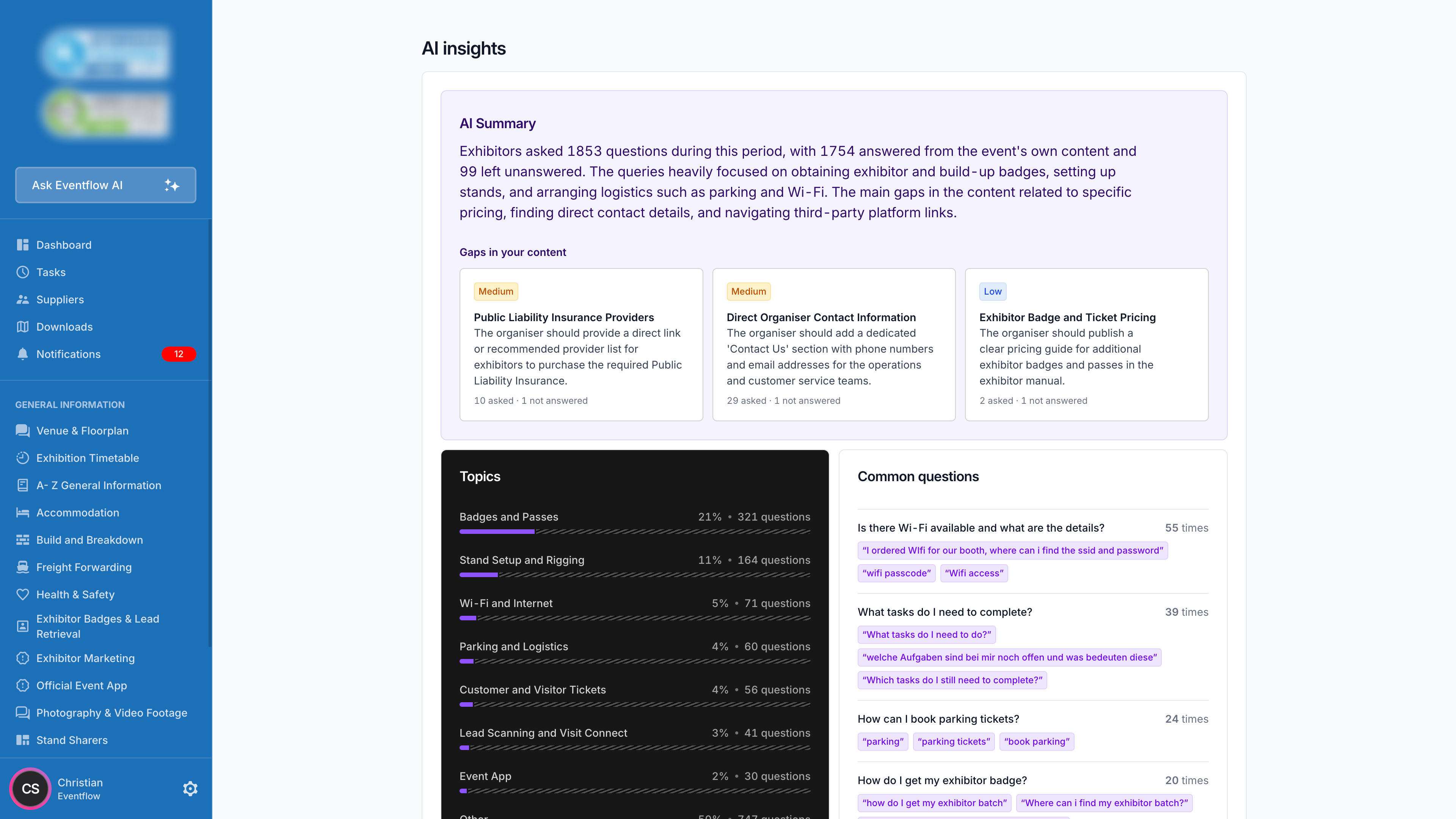
AI reporting: Learning from every conversation
Answering questions is one part of the opportunity. The other is understanding what those questions reveal.
Every interaction with an AI assistant creates an additional source of feedback about the participant experience. When viewed collectively, those conversations can reveal recurring subjects, changes in information requirements and opportunities to make guidance more useful.
Eventflow's AI reporting helps organisers review this activity, identify common questions, highlight gaps in event information and understand how participants are engaging with the platform.
There are several practical ways this could support event operations:
1. Improve the information exhibitors receive
If exhibitors regularly ask about a particular requirement, organisers can review how that information is presented. Perhaps it needs a clearer explanation, a more prominent position in the manual or a practical step-by-step guide.
2. Make communications more relevant
Understanding when particular subjects generate the most questions can help teams plan communications around actual exhibitor needs. That could mean providing earlier guidance on stand construction, followed by more focused information about access and arrival as the event approaches.
3. Identify where personal support adds the most value
AI can provide guidance on routine requirements, while conversation reporting can help identify where further explanation or individual attention may be useful. The aim isn't to remove the personal element from event ops. It's to help teams understand where their expertise and support will make the greatest difference.

From individual events to better ways of working
For organisers responsible for multiple exhibitions, the potential extends beyond a single event.
Most operations teams already review what worked well and what could be improved after each show. AI conversation reporting could provide another valuable input into that process.
Instead of relying solely on post show surveys, team feedback and anecdotal evidence, organisers can review the questions participants actually asked during preparation.
- Which subjects appeared repeatedly?
- Did particular enquiries increase as the event approached?
- Were there questions that required additional explanation?
These insights could inform improvements to exhibitor manuals, communication schedules and onboarding workflows. And where events share similar processes, those improvements could potentially be applied across a wider portfolio.
Of course, message volumes alone don't tell us how much staff time has been saved or whether every enquiry was successfully resolved. Those outcomes need separate measurement, but the conversations do provide something useful: a direct record of the information participants were looking for.
That makes them a valuable starting point for continuous improvement.
Better support today, better events tomorrow
What stood out from this deployment was the scale of engagement.
Nearly 500 individual accounts used the AI Assistant at one exhibition, generating more than 1,800 messages across the event lifecycle.
- For exhibitors, AI offers a more direct way to access the information they need and understand their next steps.
- For organisers, it creates an opportunity to better understand participant needs, refine communications and make more informed operational decisions.
We believe this is where AI can deliver meaningful value to the events industry and especially event ops. Not just helping organisers answer more questions, but helping them learn from every question that's asked.
See Eventflow AI in action
Want to see how Eventflow AI works in practice?
Come and meet us at Event Tech Live or IBTM World this November and we'll show you how the AI Assistant helps participants find event-specific information and how AI reporting gives organisers useful insights into their questions, priorities and support needs.


